
4 Symptoms of Needing a New Web Developer

Today’s website content management systems can be used to craft high-quality, high-performance websites. They can also be used to pump out dozens of generic sites without much attention to quality, and the client suffers for it. If you’re experiencing many of these symptoms, it might be time to think about getting a new web developer.

1. The standard URLs and icons never changed

Common icons from CMS systems

If you still have “index.php” in your page URLs, or have the logo of your CMS showing on your browser tab, it suggests that whoever built your site was maybe trying to do it as quickly as possible or simply didn’t know how to correctly configure the site and server. It is a quick fix for those who know how, it will make a big difference to how users perceive your site, and might even improve your search ranking.

2. Maintenance requests take way too long

Did your web developer abandon you after completing your site? Good companies respond to emails and phone messages quickly, and will let you know how long it will take to finish a job if they can’t do it right away. If this is the normal pattern with your developer, demand more.

3. Your site looks just like every other site out there

Generic-looking website template
Pretty boring!

That site template looked pretty snazzy when you first saw it. Great big photo on the home page with text overlaying it. Maybe even a slideshow with a big button to click. Down the page were alternating content areas—first dark on light, then light on dark. Little background effects when you scroll. Three or four feature boxes with icons, placed side-by-side. Ever noticed that your competitor has the exact same thing?

It’s going to cost more, but doing a custom site template or scratch-built site will help you escape the monotony of today’s mobile-compatible, pre-built template websites.

Suggestion: take a look at the FWA site for inspiration. Make note of what is possible, then find a web developer that can go beyond convention, combining design skill and programming prowess. For good graphics, a good place to start is someone who is certified with the Graphic Designers of Canada or another design certification group. For the programming side, visit the portfolios of different interactive agencies to get an idea of their repertoire.

4. Not truly mobile

They might fit on your phone screen, but many sites nowadays will still send over five megabytes, sometimes even ten or more on the first page download. This might be suitable for a desktop experience, but why should mobile users receive this same amount of data, when their screens are smaller and their data is not unlimited? There are great solutions nowadays for giving mobile users only what they need, and fast. Ask your developer what can be done to maximize mobile performance. If they don’t know, it might be time to ask someone else.

Conclusion

You could add more points to this list but when it comes down to it a website design company needs to have technical expertise joined with quick expert service. Combine these with a good price and you will have satisfaction with your web presence for years to come.

Confidant Communications does web design in Saskatoon, Saskatchewan — serving clients from anywhere in the world. Browse our portfolio then give us a call to see what we can do for you!
Video Production for an Illustrated Drawing Video

I recently did a fun personal project illustrating and reciting nursery rhymes for my son with special needs, and other kids who need low-intensity entertainment.

At first glance there doesn’t seem to be much production effort involved – just a sketch book and a sharpie. Permit me to share a bit about the things unseen.

To the right of the filming area I kept the nursery rhyme book I was using. To the left was my laptop and microphone. I am sorry that I don’t have a picture at this time.

The video was filmed using a Nikon D90 digital SLR attached to a tripod, suspended over my work table. This worked nicely but was limited to filming 5 minutes at a time in the highest resolution. The other limitation was the camera’s microphone was neither high-quality nor positioned close enough to capture my voice very well.

For audio I used an AT2035 condenser microphone plugged into an M-Audio Fasttrack Pro sound capture board, which was in turn plugged into my Mac via USB. My recording software of choice was Audacity. After recording the high-quality audio, I used the Normalise and Noise Reduction filters (which were hardly needed) to make the quality top-notch.

Recording happened in a series of starts and stops. Sometimes I attempted a rhyme which did not lend itself well to drawing. Other times the camera would come to the end of its time limit and I would need to start over.

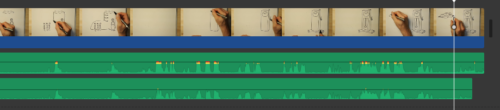
When finished recording I had a couple dozen video files from the camera, and I exported multiple MP3 files from Audacity. I imported the video and audio into iMovie and began to edit out the unwanted portions and add fade transitions between clips. I split the low-quality audio from the video track. This allowed me to see the waveform of the original audio and align them perfectly with the imported high-quality MP3 files beneath. Once that was done, I would put the audio level of the low-quality track above to zero.

I was not satisfied with the white balance of the video (it was too yellow) so I adjusted that easily using the iMovie controls.

I wanted a good quality title screen so I sped up the drawing portion of that, and spent a few minutes in GarageBand to record the jingle. After plugging into my electric piano via a USB MIDI convertor, I selected an appropriate keyboard voice from the many options. I had to start the recording in GarageBand, then switch to iMovie to start the video so I could play the jingle in time to the drawing. After doing that I exported an AIFF file and imported that into iMovie for the final cut.

iMovie has the wonderful option of publishing directly to YouTube, so I used that. It took quite a while to upload the 72-minute video but it went smoothly.

All told it was about a full day of work from start to completion. If you know of anybody who would enjoy the video, please share it with them!

How to force Firefox, Chrome and Safari for Mac to display scrollbars

Since OS X Lion came out, Macs have had the strange habit of making scrollbars disappear when an HTML div element is overflowing but not actively scrolling. This puzzles me because usually Macs are great for user interface improvements, and this is a step backward in my opinion. Sure, Mac users have the option of re-enabling the scroll behaviour, but web developers want to make sure people know to scroll.

There is no cross-browser way of fixing this with just CSS according to my research, so I came up with this solution using JavaScript:

First, use this CSS to make sure your div is set to show scrollbars:


.mydiv{ overflow-y:auto; }

Then attach this script to your page (this requires JQuery).

var sc;
jQuery(document).ready(function(){
	//constantly update the scroll position:
	sc=setInterval(scrollDown,200);

	//optional:stop the updating if it gets a click
	jQuery('.mydiv').mousedown(function(e){
		clearInterval(sc);            
	});
});
function scrollDown(){
	for(i=0;i<=jQuery('.mydiv').length;i++){
		try{
		var g=jQuery('.mydiv')[i];
		g.scrollTop+=1;
		g.scrollTop-=1;
		} catch(e){
		//eliminates errors when no scroll is needed
		}
	}
}

Purists may object to using a JavaScript loop in this way. Sorry, but sometimes when you want bacon you have to butcher a pig. :)